#include <synthetic.hpp>
Public Member Functions | |
| double | evaluate (inst::set x) override |
 Public Member Functions inherited from syn::synthetic Public Member Functions inherited from syn::synthetic | |
| synthetic (const std::string &n, u_int dims, double lb, double ub, double opt) | |
| synthetic (const std::string &n, u_int dims, double opt) | |
| ~synthetic () | |
| sspace::sspace_t * | get_search_space () |
| void | set_properties (std::vector< properties > p) |
| std::vector< properties > | get_properties () |
| inst::set | get_opt_param () |
| double | get_opt () |
| void | update_opt (double opt) |
| u_int | get_dims () |
| void | validate_param_set (inst::set x) |
| Public Member Functions inherited from optk::benchmark | |
| benchmark (const std::string &name) | |
| std::string | get_name () |
Additional Inherited Members | |
| Protected Member Functions inherited from syn::synthetic | |
| void | set_opt_param (inst::set op) |
| Protected Attributes inherited from syn::synthetic | |
| u_int | m_dims |
| double | m_lb |
| double | m_ub |
| double | m_opt |
| std::vector< properties > | m_properties |
| inst::set | opt_params |
| sspace::sspace_t | m_sspace |
| Protected Attributes inherited from optk::benchmark | |
| std::string | m_name |
Detailed Description
The adjiman function has formula
\[ f(x) = \cos(x_1)\sin(x_2) - \frac{x_1}{(x_2^2+1)}, \]
with only two parameters \(x_1\) and $fx_2$f, subject to \(-1 \le x_1 \le 2\) and \(-1 \le x_2 \le 1\). The global minimum is located on the boundary of the search space at \(\mathbf{x}^* = (2, 0.10578)\), with minimum $ff({x}^*) = -2.02181 \(. */ class adjiman: public synthetic { public: adjiman (); double evaluate(inst::set x) override; }; /** The alpine1 function has formula \f[ f(x) = \sum^D_{i=1}\left\vert x_i\sin(x_i) + 0.1 x_i\right\vert, \f] with \) \( parameters subject to \)-10 x_i 10 \(. The global minimum is located at the origin; \){x}^* = (0, , 0) \(, with value \$ff(\mathbf{x}^*) = 0\). */ class alpine1: public synthetic { public: alpine1 (int dims); double evaluate(inst::set x) override; };
/** The alpine2 function has formula
\[ f(x) = \prod^D_{i=1}\sqrt{x_i}\sin(x_i), \]
with \(D\) parameters subject to \(0 \le x_i \le 10\). The global minimum is located at \(\mathbf{x}^* = (7.917, \ldots, 7.917)\), with value $ff({x}^*) = 2.808^D \(. */ class alpine2: public synthetic { public: alpine2 (int dims); double evaluate(inst::set x) override; }; /** The brad function comes from 'A Comparison of Gradient Methods for the Solution of Nonlinear Parameter Estimation Problems' (https://doi.org/10.1137/0707011), and is a modified version of Problem 1, p170. We give it the formula \f[ f(x) = \sum^15_{i=1}\left[ \frac{y_i - x_1 - i} {(16-i)\cdot x_2 + \min(i, 16-i)\cdot x_3} \right]^2, \f] where \) = [0.14, 0.18, 0.22, 0.25, 0.29, 0.32, 0.35, 0.39, 0.37, 0.58, 0.73, 0.96, 1.34, 2.10, 4.39]^T \(. The three parameters are subject to \)-0.25 x_1 0.25
\[ w_i = 1 + \frac{x_i - 1}{4}, \forall i \in \{1, \ldots, d\}. \]
.01 x_2, x_3 2.5 \(. The global minimum is located at \){x}^* = (0.08241040, 1.133033, 2.343697)$, with \((\mathbf{x}^*) = 0.00821488 \). */ class brad: public synthetic { public: brad (); double evaluate(inst::set x) override; };
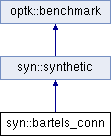
/** The bartels conn function has the formula
\[ f(x) = \vert x_1^2 + x_2^2 + x_1x_2\vert + \vert \sin(x_1)\vert + \vert \cos(x_2)\vert, \]
subject to \(-500 \le x_i \le 500\), with the global minimum located at \(\mathbf{x}^* = (0,0)\), with \(f(\mathbf{x}^*) = 1\).
Member Function Documentation
◆ evaluate()
|
overridevirtual |
Evaluate the benchmark (i.e. calculate the value of the objective fuinction) on the provided values.
- Parameters
-
x A vector of double-precision values to evaluate the benchmark at.
- Todo:
- Verify that a vector of doubles does not constrict the range of benchmark functions which may be evaluated (i.e. as opposed to categorical variables such as strings).
Implements optk::benchmark.
The documentation for this class was generated from the following files:
- includes/benchmarks/synthetic.hpp
- src/benchmarks/synthetic.cpp