#include <optimiser.hpp>
Public Member Functions | |
| optimiser (std::string name) | |
| ~optimiser () | |
| virtual void | clear () |
| std::string | get_name () |
| virtual void | update_search_space (sspace::sspace_t *space) |
| virtual inst::set | generate_parameters (int param_id) |
| virtual void | receive_trial_results (int param_id, inst::set params, double value) |
| void | accept (optimisers *o) |
Protected Member Functions | |
| void | add_to_trials (int param_id, inst::node *n) |
Protected Attributes | |
| std::unordered_map< int, inst::set > | trials |
Private Attributes | |
| std::string | m_name |
| uint | stepidx |
| double | best_val |
| inst::set * | best_params |
Detailed Description
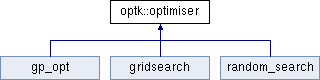
This is the base class that every optimisation algorithm will inherit.
Constructor & Destructor Documentation
◆ optimiser()
| optk::optimiser::optimiser | ( | std::string | name | ) |
The constructor
- Parameters
-
name The identifiying name of this optimisation algorithm.
◆ ~optimiser()
| optk::optimiser::~optimiser | ( | ) |
The destructor will free any generated parameter instances not freed by explicit calls to receive_trial_results.
Member Function Documentation
◆ accept()
| void optk::optimiser::accept | ( | optimisers * | o | ) |
Uses the visitor pattern to register an optimiser with the optimisers class.
- Parameters
-
o A pointer to the optimisers class with which to register this optimiser.
- Todo:
- is this method necessary?
◆ add_to_trials()
|
protected |
This will add a parameter configuration allocated on the heap to the optimiser::trials map, so that it may be freed later by the optimiser's destructor. If a trial configuration already exists with the same param_id, those values will be freed, and the value in the map will be replaced.
- Parameters
-
param_id The identifier for this trial. n The root node of the concrete parameter settings.
◆ clear()
|
virtual |
Clears / resets this optimiser. This should be the same as calling the destructor and then the constructor.
Reimplemented in gridsearch.
◆ generate_parameters()
|
inlinevirtual |
This is the method invoked to generate the next trial's parameters for the benchmark or program being optimised.
- Parameters
-
param_id An identifier for this parameter trial; this may or may not be used by the optimistaion algorithm.
- Returns
- A pointer to an inst::node, or a NULL pointer if there are no more parameters to return.
Reimplemented in gridsearch, gp_opt, and random_search.
◆ get_name()
|
inline |
- Returns
- the optimiser's name
◆ receive_trial_results()
|
inlinevirtual |
Allows the benchmark or program being optimised to communicate back the value of the cost function for a parameter set.
- Parameters
-
param_id This parameter id is used to identify the parameters used to generate the result. parameters For increased flexibility, the actual parameters used to generate the result are also copied back. value The actual value of the objective function.
Reimplemented in gridsearch, gp_opt, and random_search.
◆ update_search_space()
|
inlinevirtual |
This updates the search space defined by the optimiser.
- Parameters
-
space The new search space to use
Reimplemented in gridsearch, gp_opt, and random_search.
Member Data Documentation
◆ best_params
|
private |
The parameters which gave rise to the best_val
◆ best_val
|
private |
The best found value of the function
◆ m_name
|
private |
The optimisation algorithm's name
◆ stepidx
|
private |
stepidx is used to generate sequential parameter IDs during step
◆ trials
|
protected |
This is used to keep track of previously generated instances or settings of the parameters, identified by the parameter id passed to the generate_parameters method. Contains elements stored on the heap.
The documentation for this class was generated from the following files:
- includes/optk/optimiser.hpp
- src/optimiser.cpp