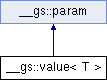
Inheritance diagram for __gs::value< T >:
Public Member Functions | |
| value (const std::string &k, pspace_t t) | |
| value (const std::string &k, std::vector< int > v) | |
| value (const std::string &k, std::vector< double > v) | |
| value (const std::string &k, std::vector< std::string > v) | |
| std::vector< T > * | get_vals () |
| T | at (unsigned int i) |
| T | current () |
| void | set (std::vector< T > vs) |
| unsigned int | get_count () |
| bool | next (T *val) |
 Public Member Functions inherited from __gs::param Public Member Functions inherited from __gs::param | |
| param (const std::string &k, pspace_t t) | |
| pspace_t | get_type () |
| std::string | get_key () |
Private Attributes | |
| std::vector< T > | m_values |
| unsigned int | m_i |
| unsigned int | m_max |
Detailed Description
template<class T>
class __gs::value< T >
Value contains lists of integers, doubles or strings.
Member Function Documentation
◆ get_count()
template<class T >
|
inline |
Returns the cardinality of the set of values for this parmeter.
◆ next()
template<class T >
|
inline |
Next will iterate through the enumerated values for this parameter, and update the val parameter to be the next one along. If this is the first value in the set, then this function will return true, otherwise it will return false.
- Parameters
-
val The value to be updated with the next parameter.
- Returns
- A boolean indicating whether the returned value was the first in the set. This occurs upon first invokation, as well as when 'wrapping around'.
The documentation for this class was generated from the following file:
- src/optimisers/gridsearch.cpp